
Technicolor Process IV · Imbibition dye-transfer
The Technicolor look.
Reconstructed from the real process.
A physically-based reconstruction of Process IV dye transfer, calibrated against real Technicolor film.

DaVinci Resolve

Premiere Pro

After Effects

Final Cut Pro

Motion
What you’ll see.
Real footage, graded through the full Nx 3‑Strip pipeline. Scroll the strip; click a frame to compare it against the source.
The color that film forgot.
The impossible reds of The Red Shoes. The emerald of Gone with the Wind. Dorothy stepping into Oz. That color was never a grade — it was physics: light split through three filters, three strips of film, dye migrating through gelatin until it could hold no more. Nx 3-Strip doesn’t approximate it — it computes it, every pixel through the same chain the original light took, from prism to dye bath to projector.
One process, any look
Not a look. A process you grade with.
Every control is a physical stage of the process — printer lights, dye set, light temperature, halation, grain, print density — so the same shot can be a clean laboratory print, a warm matinee, a restrained modern grade or something nobody printed in 1948. The film presets get you there in one click. The controls take you anywhere else.





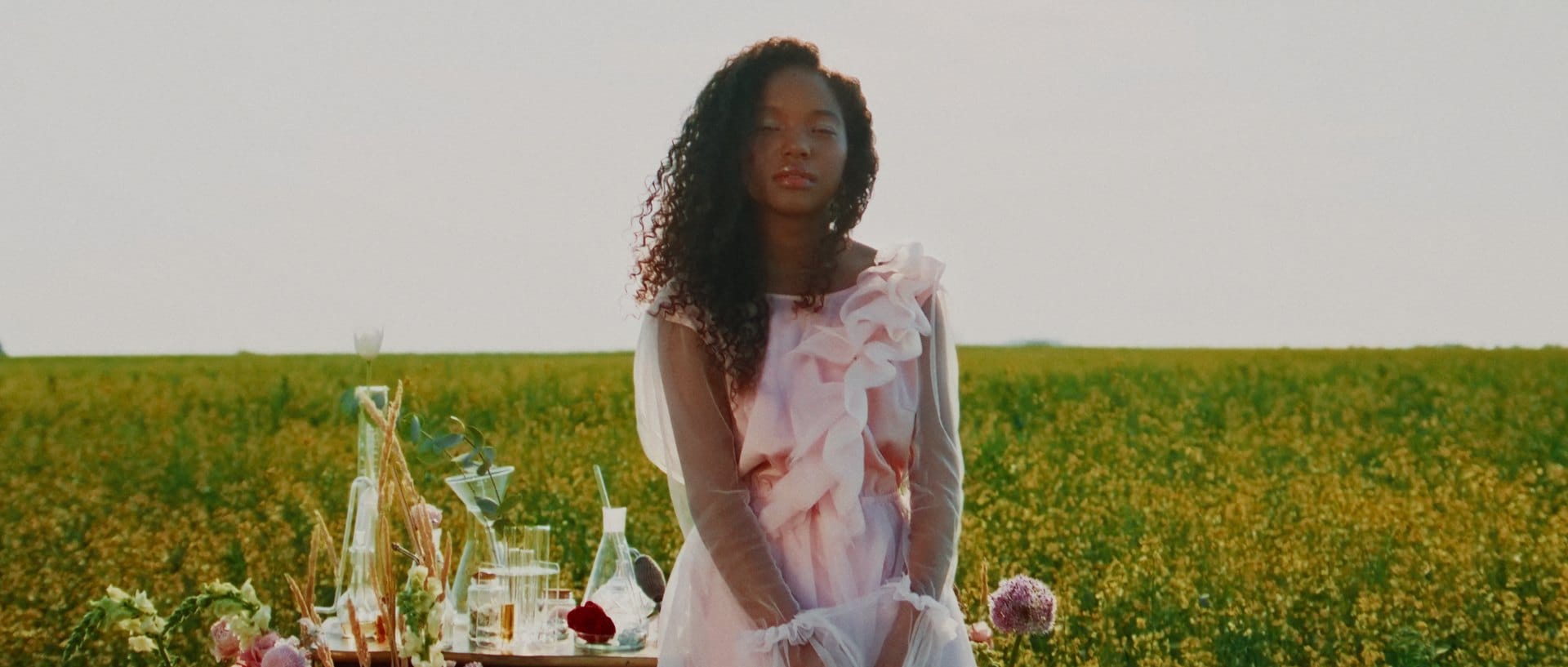
Physics, not presets
Reconstructed from the original physics.
Every frame is computed from first principles using the same optical and chemical stages that defined the original Technicolor process.
- Three-strip colour separation
- Dye absorption and transfer
- Imbibition dye trapping
- Period-correct viewing illuminants
Calibrated against archival references, Eastman Museum materials and J. A. Ball’s original technical papers — and against the film itself: original three-strip camera negatives, period dye-transfer prints, and native-4K restorations of the reference films, measured frame by frame.
Camera negatives
Original three-strip negatives, scanned
Where the record softness, the red-record blur and the camera-side halation come from.
Dye-transfer prints
Period imbibition prints, frame by frame
Where the dye set, the tone-tint trajectory and the print grain are measured.
4K restorations
Native-4K masters of the reference films
Where the film presets, the colour corridors and the halation character are calibrated.
Not a LUT. Not a preset. The process itself, rebuilt.
Historic references & technical sources
Ball, J. A. (1935). “The Technicolor Process of Three Color Cinematography.” Academy Technicians Branch Technical Bulletin. Hollywood: Academy of Motion Picture Arts and Sciences. May 31, 1935.
Hoch, W. C. (1942). “Technicolor Cinematography.” Journal of the Society of Motion Picture Engineers, Vol. 39, August 1942, pp. 96–108.
Kalmus, H. T. (1938). “Technicolor Adventures in Cinemaland.” Journal of the Society of Motion Picture Engineers, Vol. 31, December 1938, pp. 564–584.
Works where you do
Native to the app you already edit in.
Most editors and colorists live in a single app — so Nx 3‑Strip runs natively in whichever one you use: DaVinci Resolve, Premiere Pro, After Effects, Final Cut Pro or Motion. One shared physics core means the Technicolor look is pixel‑for‑pixel identical in every host.
DaVinci ResolveOPENCL · CPU
Premiere ProCPU FALLBACK
After Effects8 · 16 · 32-BPC
Final Cut Pro · MotionMACOS 13+
Fits any pipeline
Display-referred, scene-referred, HDR.
Drop it on a Rec.709 timeline, or run it inside a colour-managed log pipeline — the reconstruction is built for both, and it delivers HDR from the same grade.
Display-referred
Rec.709, P3, Rec.2020 timelines
Apply it and grade. Wide-gamut display sources get smooth out-of-gamut compression instead of channel clipping. HDR-safe display rendering with real super-white headroom.
Scene-referred
23 input formats, log and linear
ARRI LogC3/LogC4, Sony S-Log3, RED Log3G10, Canon C-Log2, V-Log, F-Log2, Apple Log, ACEScct, DaVinci Intermediate, linear EXR and more. Exposure and the film shoulder work in true scene light, and Output Encoding: Same as Source hands the finished look back to a colour-managed timeline with no double tonemap.
HDR
HDR PQ (Rec.2020) output
A dedicated PQ output with an HDR Peak control (300–1000 nits), calibrated against Technicolor HDR masters. Shadows and mid-tones match the SDR render exactly; only the highlight headroom opens up. Resolve and Adobe.
How it works
Seven stages, from prism to print.
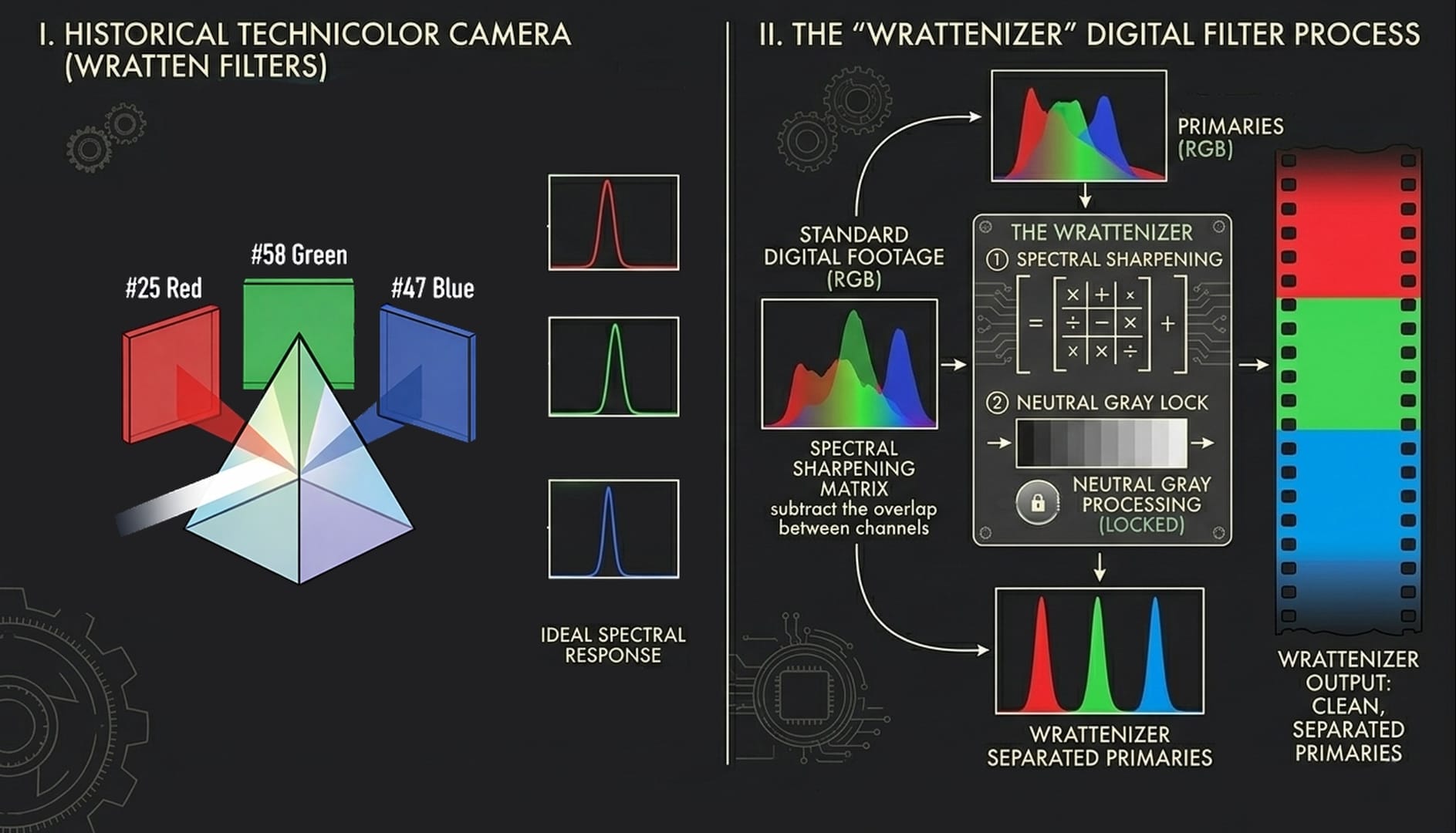
Wratten spectral separation
Three razor-sharp filters — Wratten #25, #58, #47 — carve the spectrum into pure red, green and blue with almost no overlap, the way the Technicolor beam-splitter saw the world.
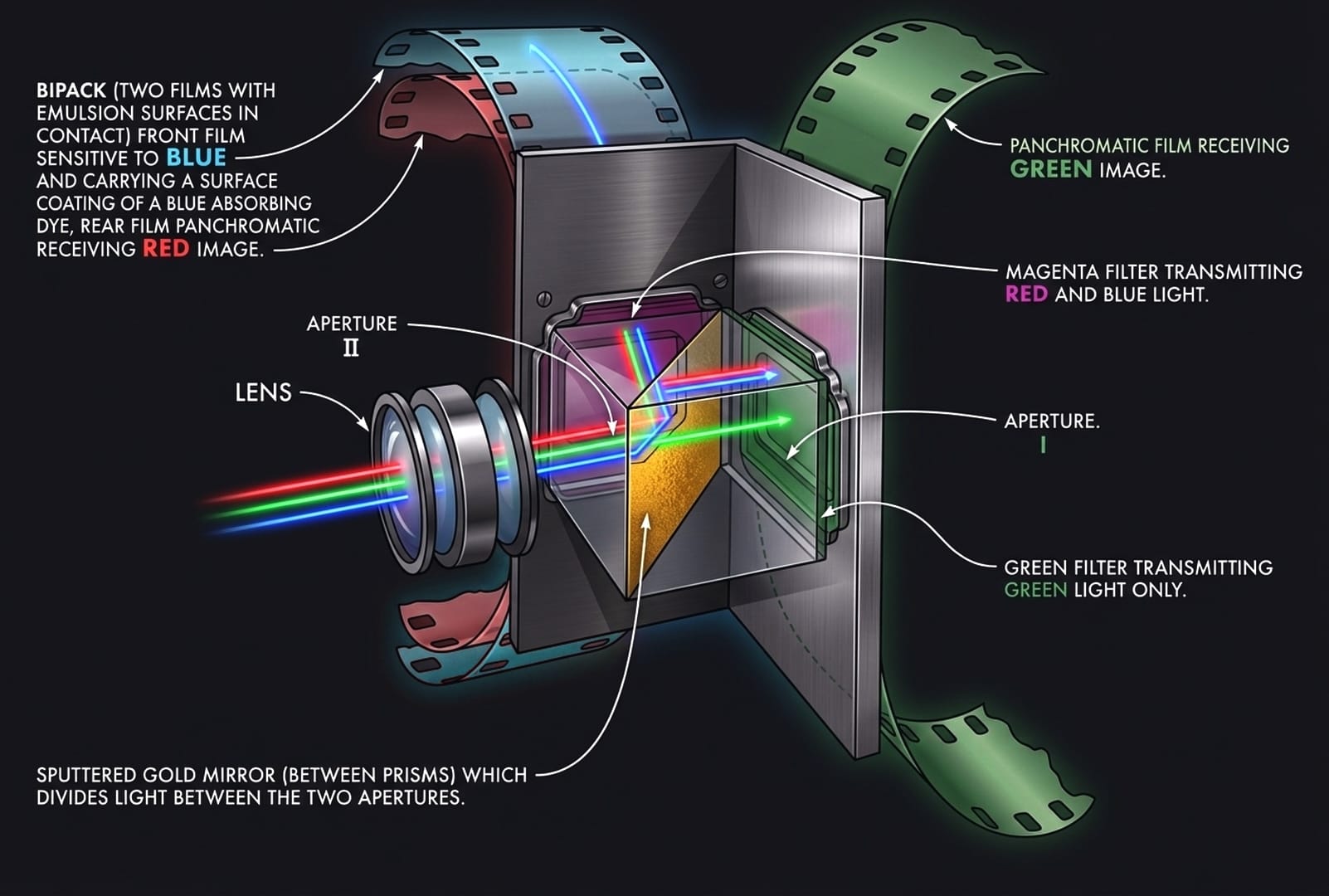
Three-strip camera
A beam-splitter prism and three strips of film, with every optical signature that came with them: light leak between records, a Petzval lens sharp at centre and soft in the corners, per-colour focus shift and edge fringing.
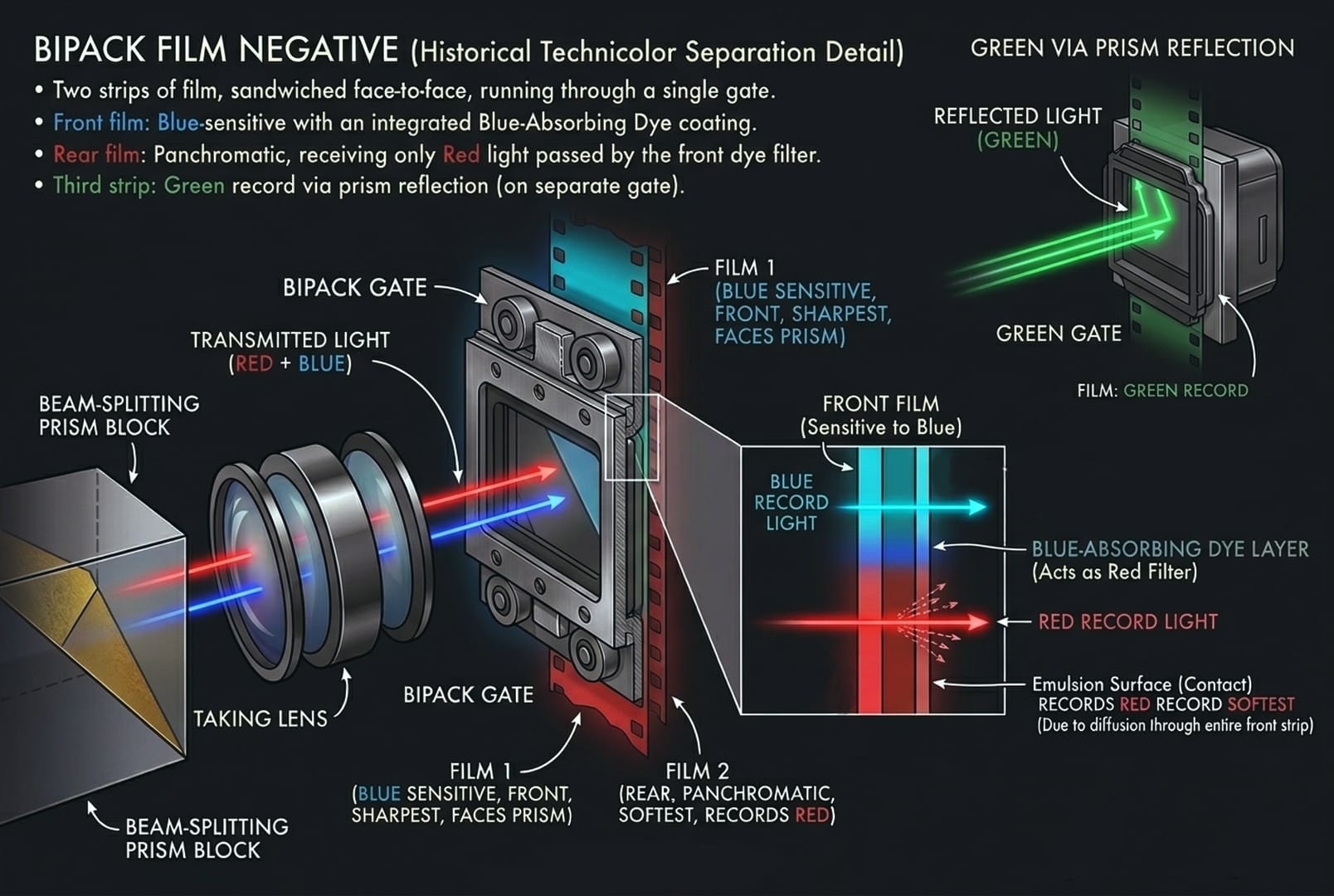
Bipack film negative
Two films sandwiched face to face — green sharpest, red softest, blue between. Light scatters through the stack into warm halation, computed per channel in the exposure domain, before the film curve.
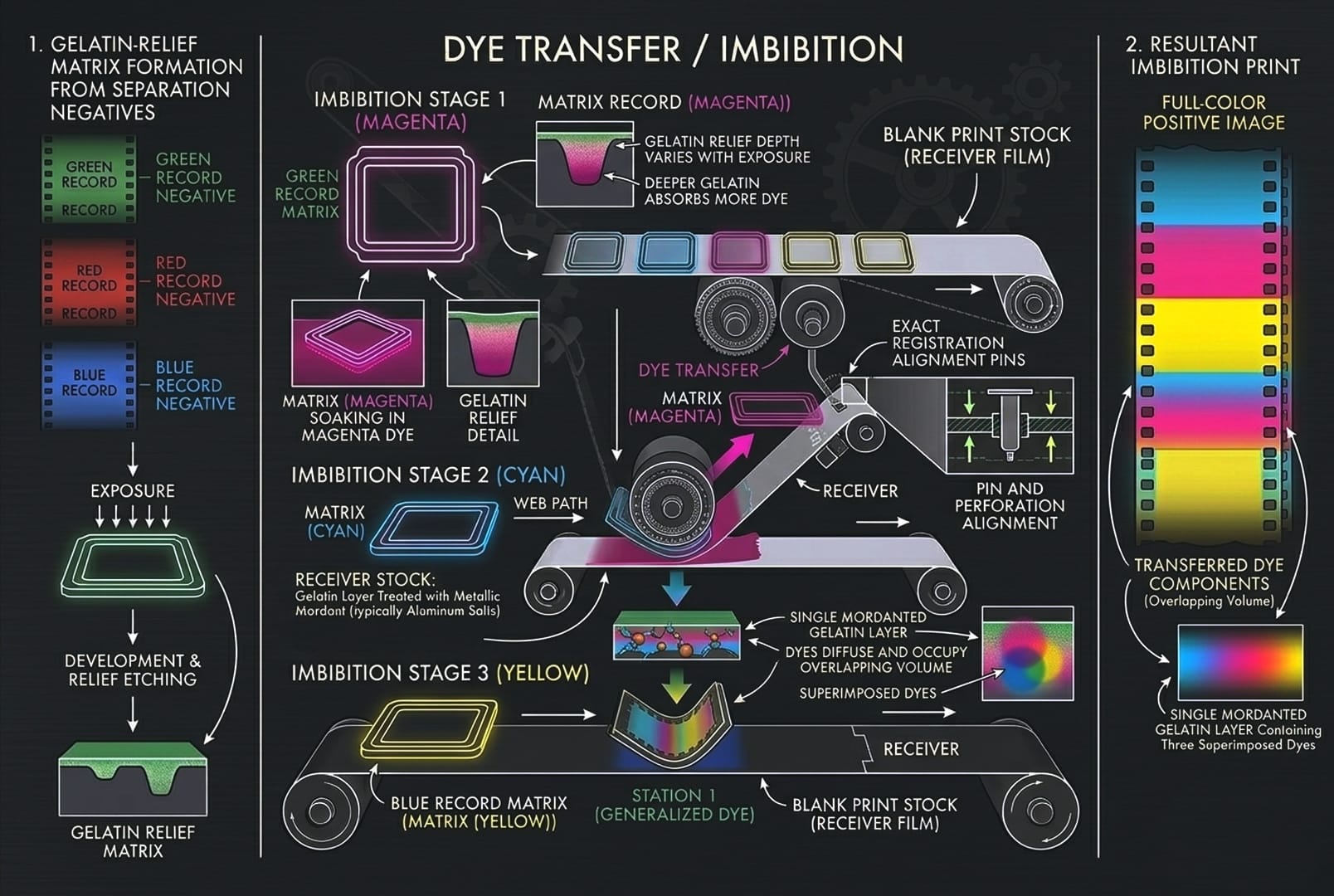
Dye transfer & imbibition
The heart of the look. Gelatin matrices soaked in dye are pressed to the print. Dyes transfer Cyan → Magenta → Yellow; by the time yellow arrives the gelatin resists and traps it in the shadows. Cool shadows, warm highlights — grown in chemistry, not graded.
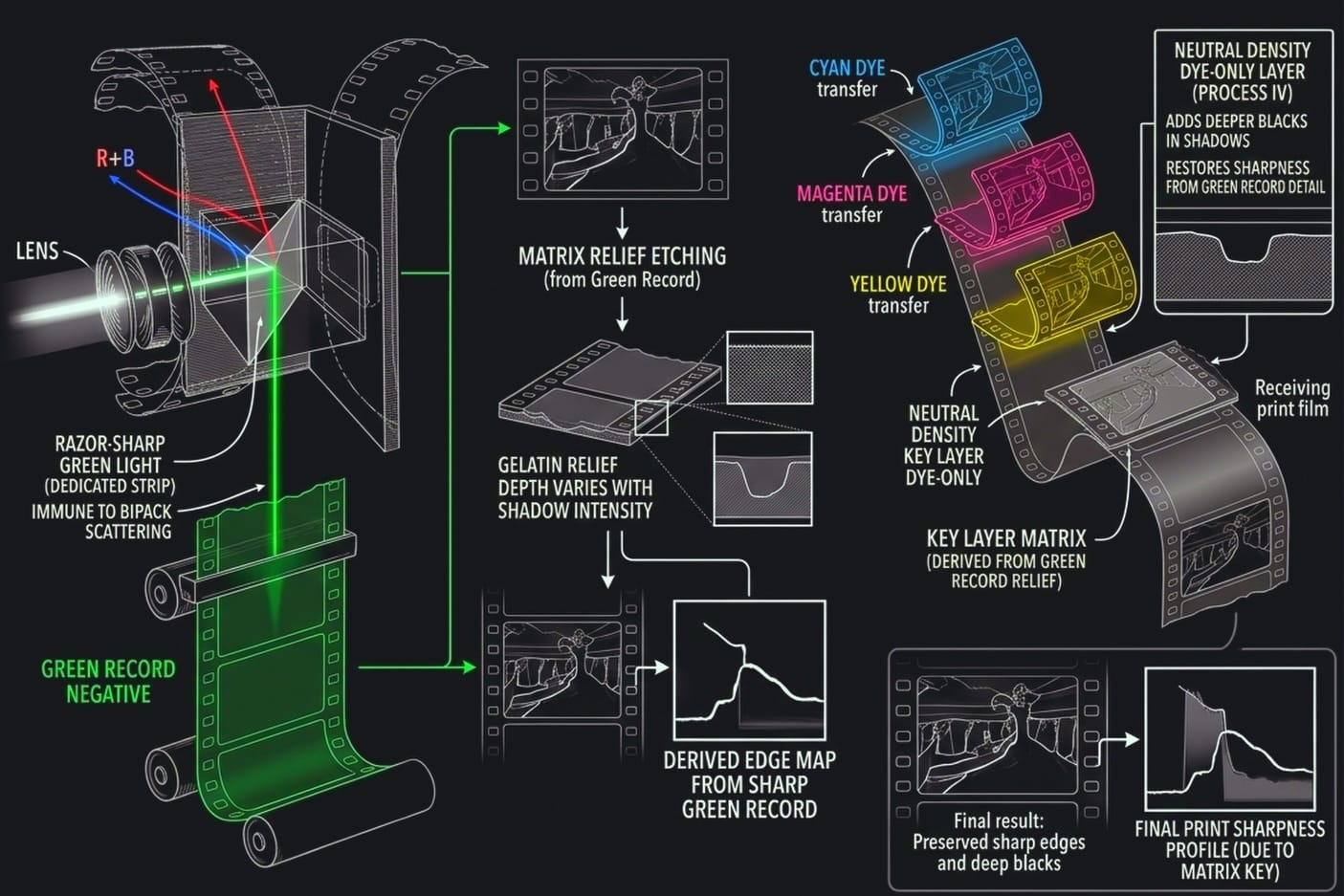
Matrix key
The sharp green record contributes a neutral-density layer — edge definition and deeper blacks from accumulated dye, exactly as Process IV worked. No retained silver.
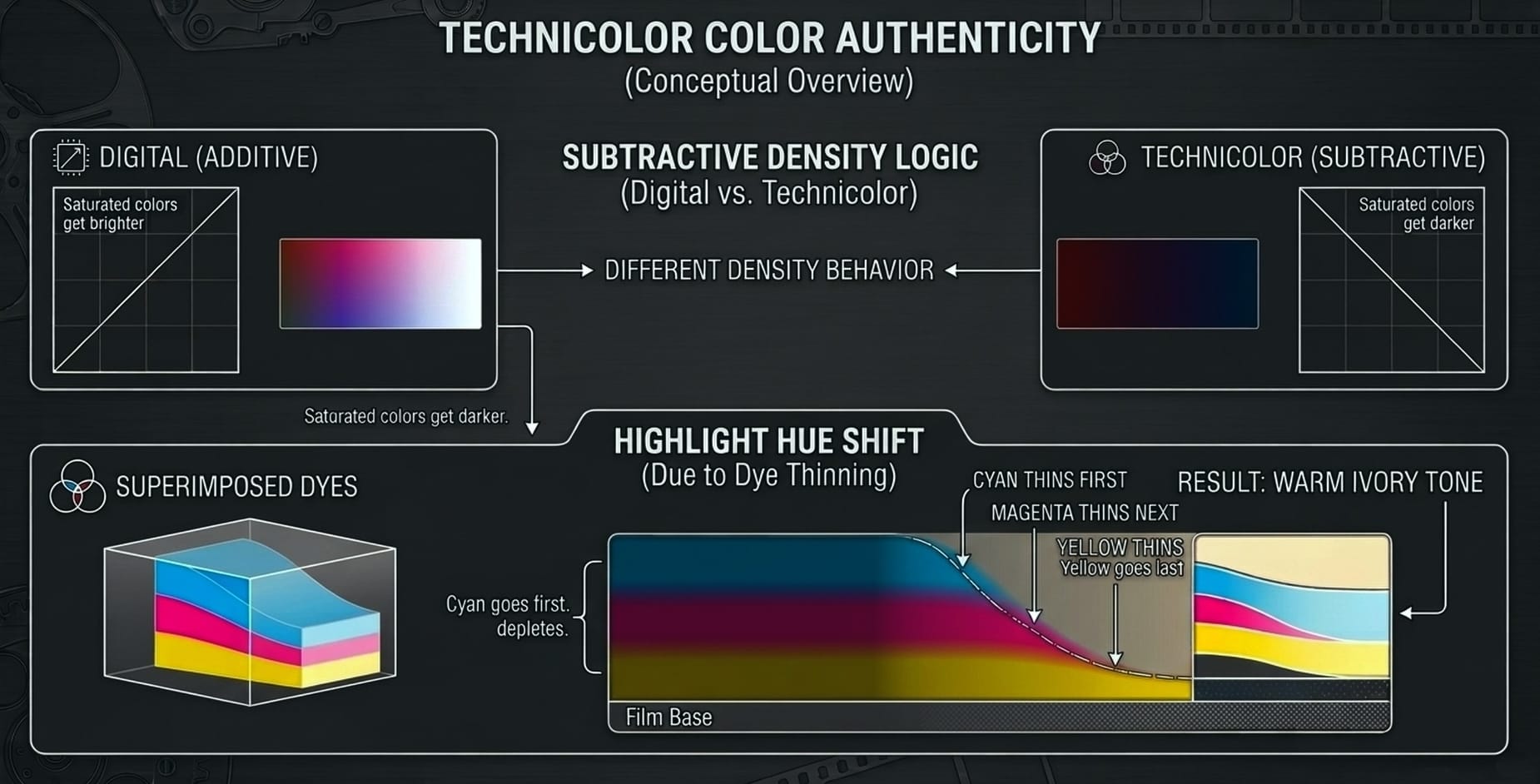
Color authenticity
Subtractive density: saturated colours get darker, not brighter. Gamut limited to the real Technicolor primaries under a 1940s carbon-arc white point, with differential highlight hue rotation toward ivory.
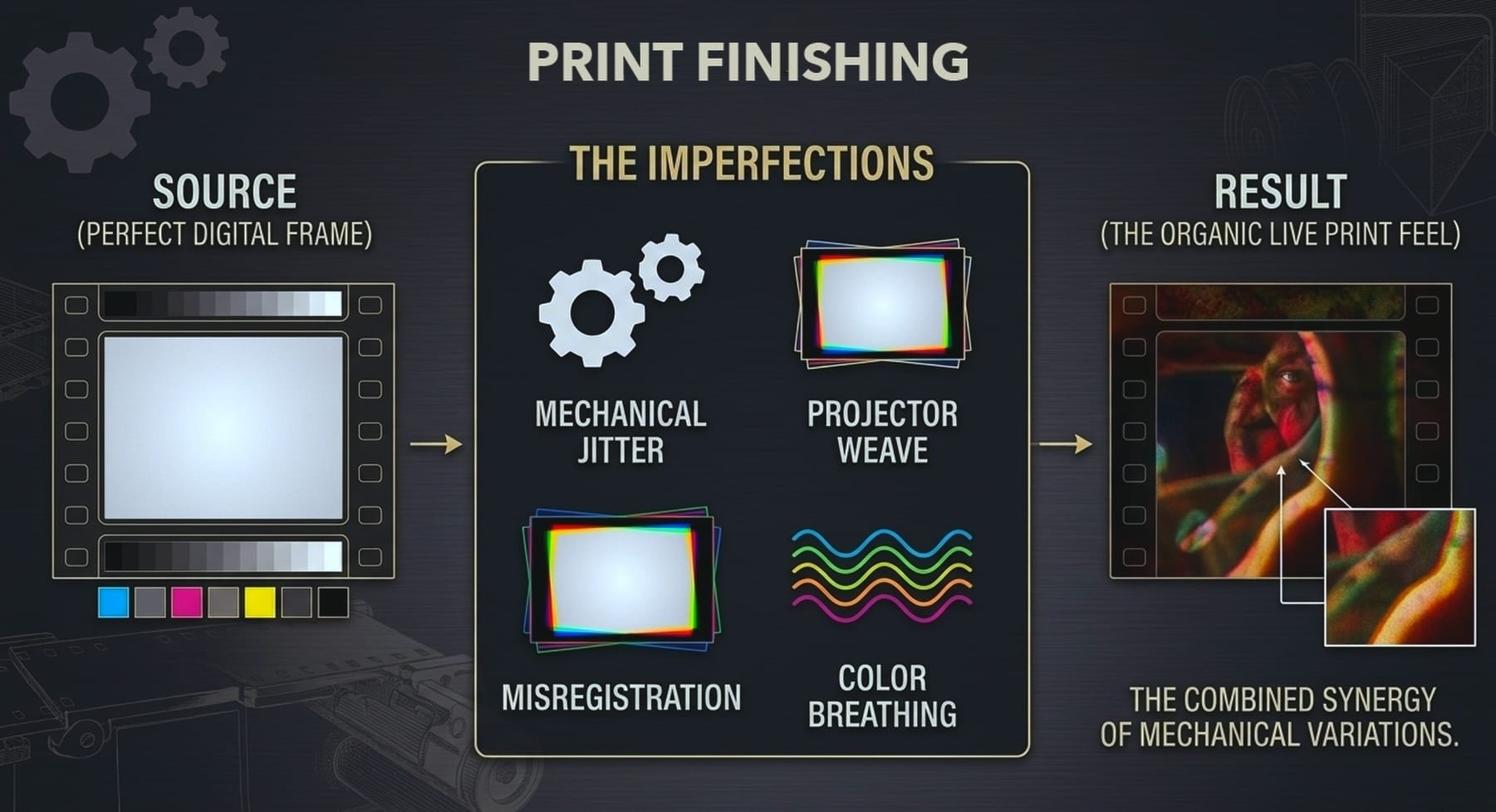
Print finishing
Per-channel misregistration, gate weave, colour breathing and film shrinkage — every mechanical signature that made a projected Technicolor print feel alive.
The grain that isn’t noise.
Why Technicolor grain looks unlike anything else — because it isn’t silver, it’s dye.
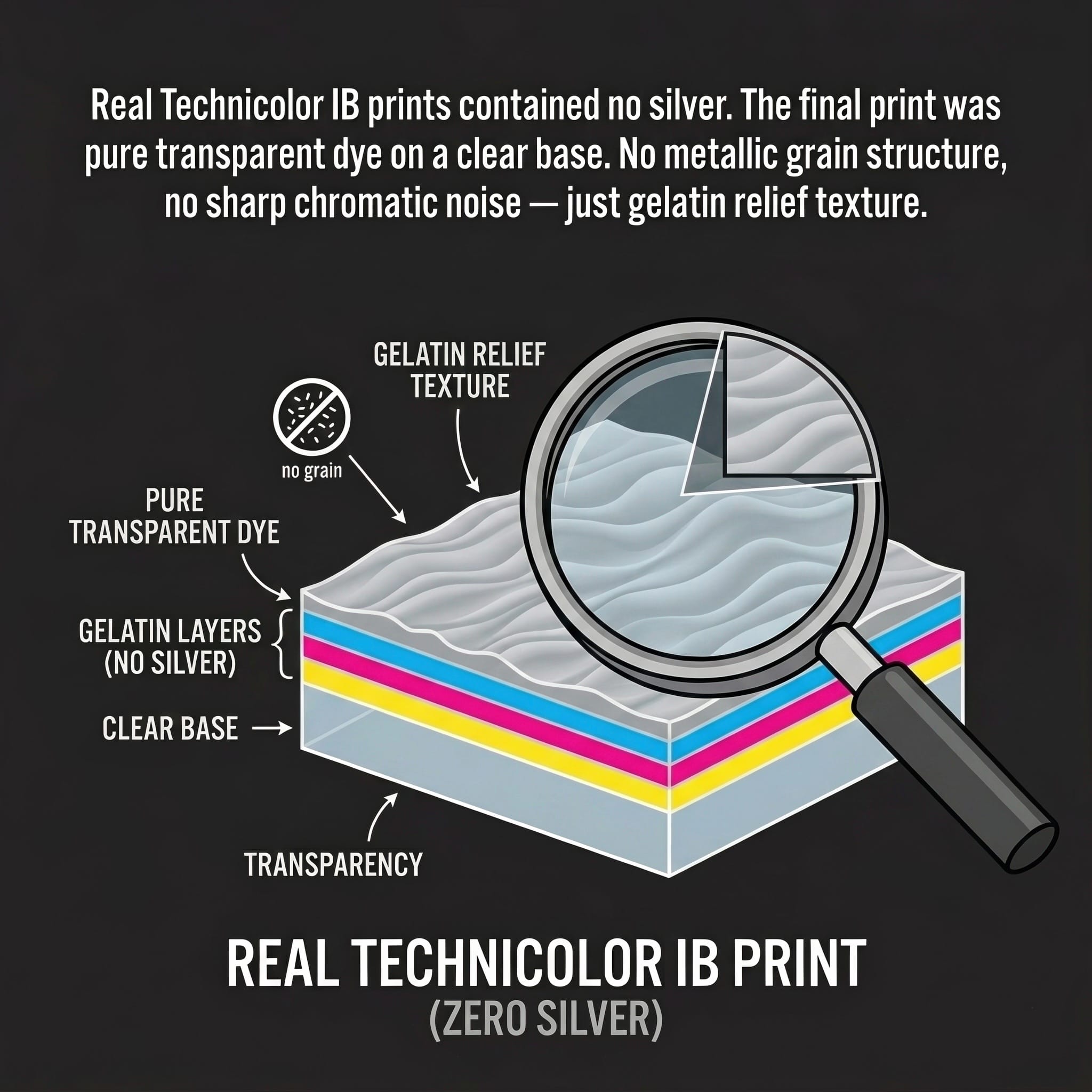
Zero silver
Real IB prints contained no silver — pure transparent dye on clear gelatin. No metallic grain, no chromatic sparkle. What you see is the hardened matrix surface, transferred during imbibition.
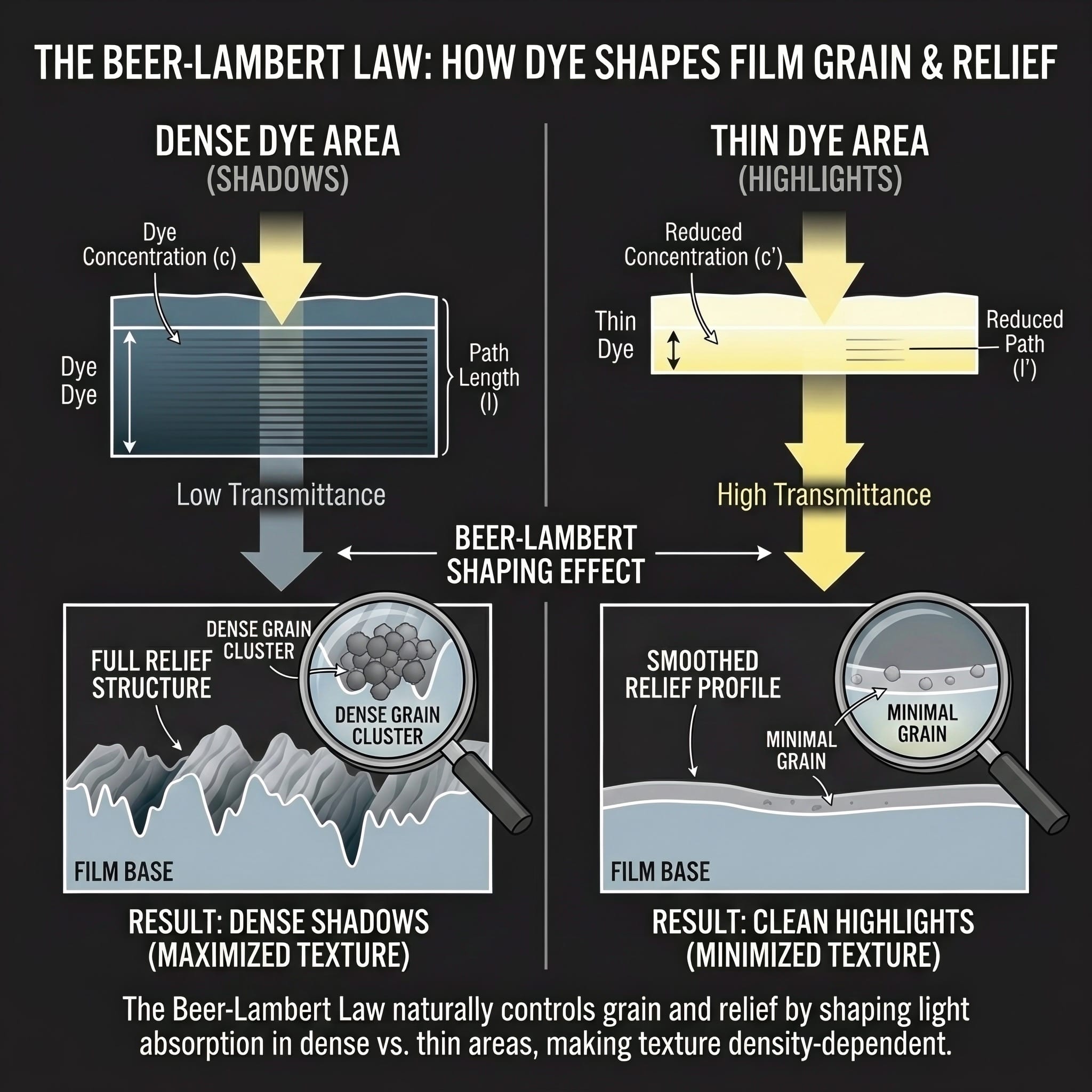
Fine grain + dye cloud
Two stages at once: the micro-texture of individual gelatin granules, plus a slow, frame-wide dye-cloud octave. Texture that lives inside the image, not on top of it.
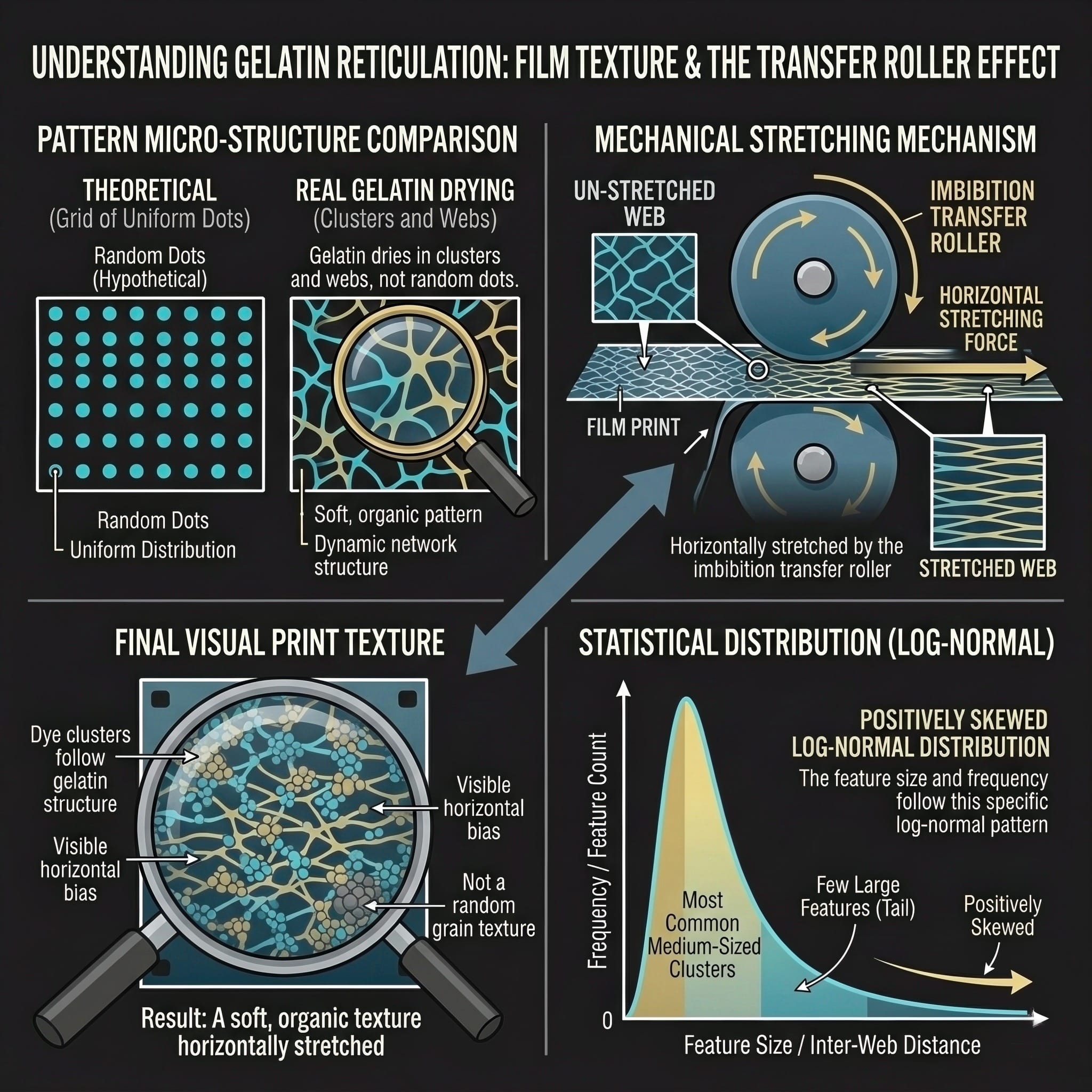
Reticulation & density
A soft honeycomb reticulation from gelatin drying, with grain applied to dye concentration — naturally dense in midtones and shadows, compressed in the highlights.
Color science
Why it looks like nothing else.
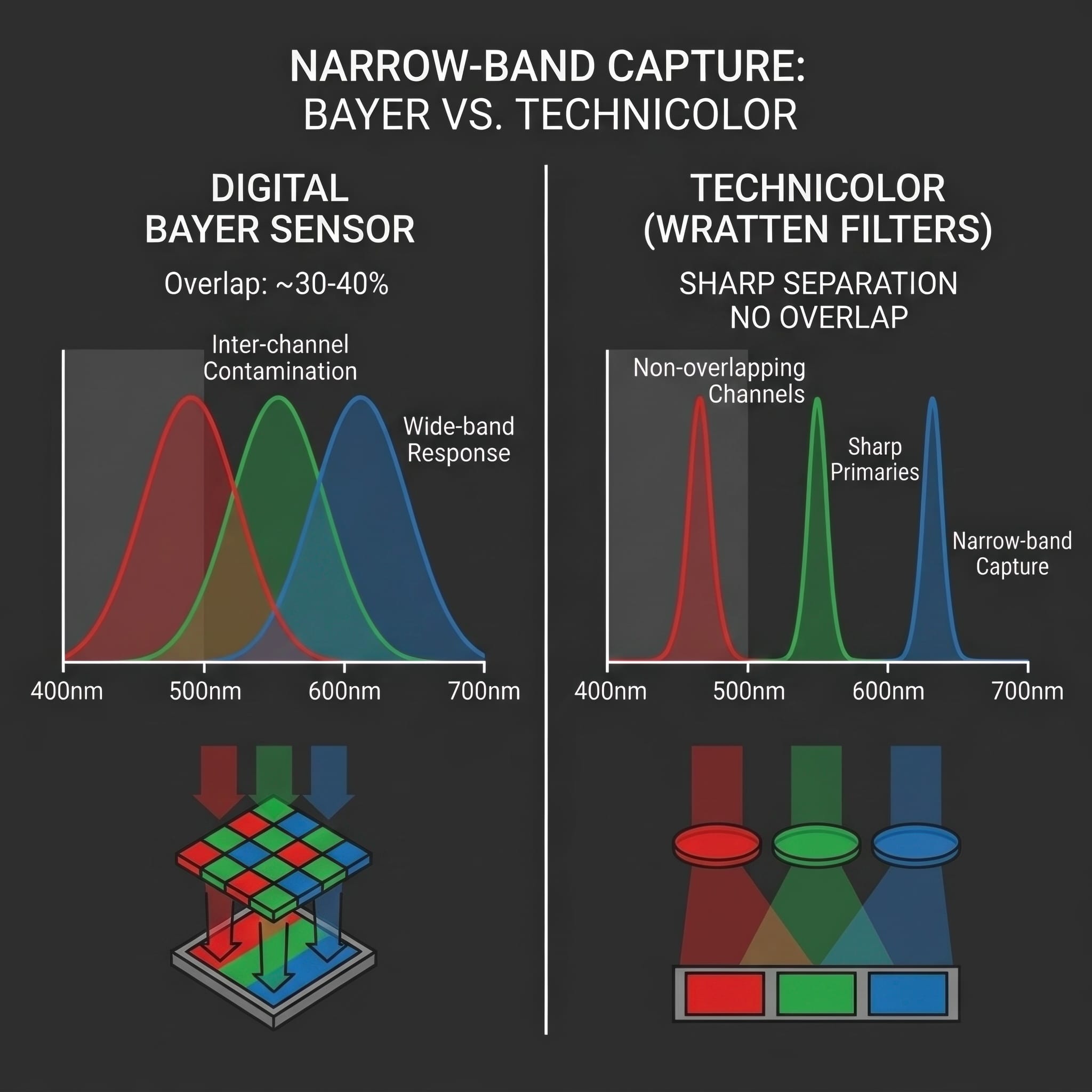
Narrow-band capture
Three non-overlapping channels. Where a Bayer sensor overlaps 50–70%, Technicolor’s separation was razor sharp — primaries never contaminate each other.
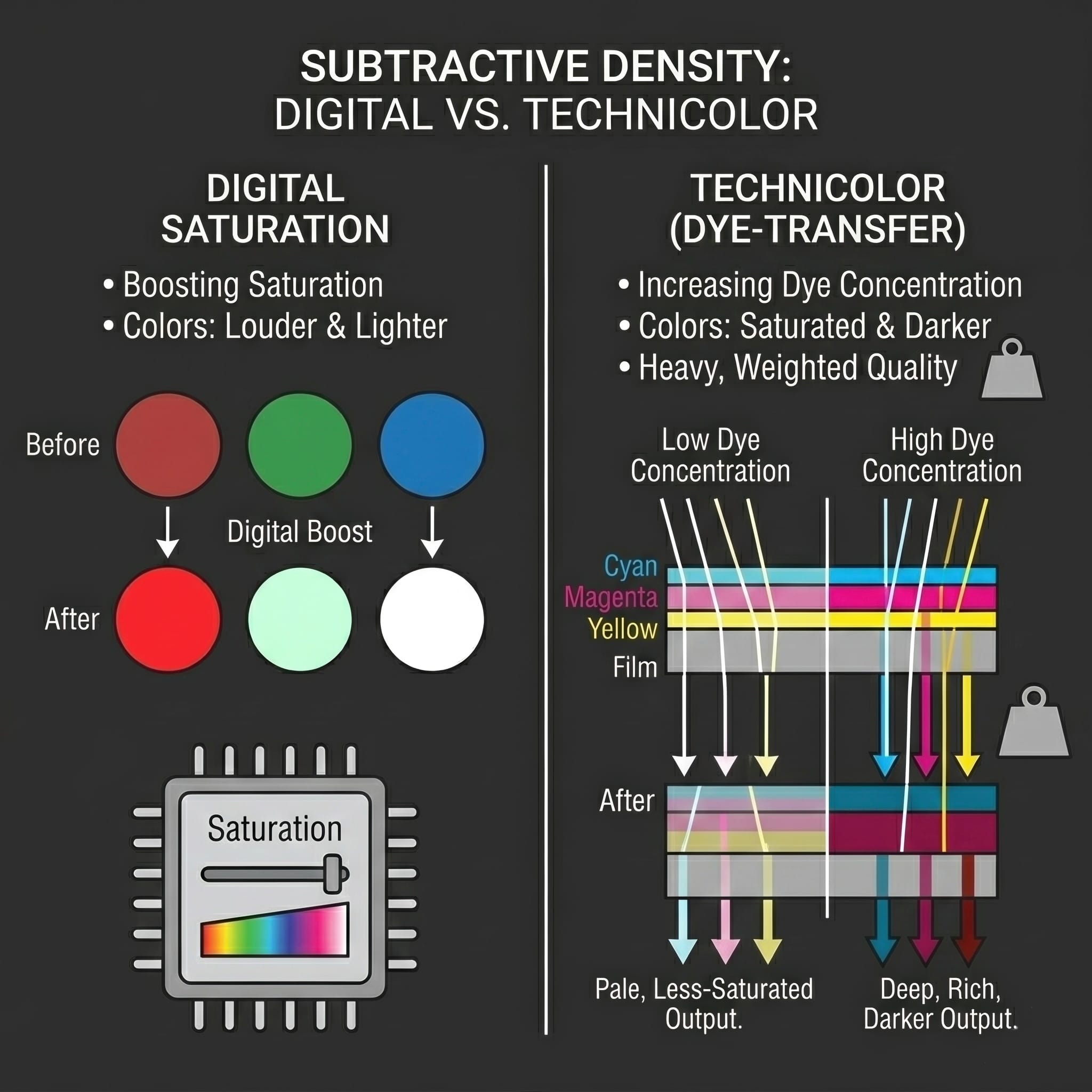
Subtractive density
In digital, more saturation means brighter. In dye transfer, more dye means darker — the heavy, weighted colour that digital saturation can’t fake.
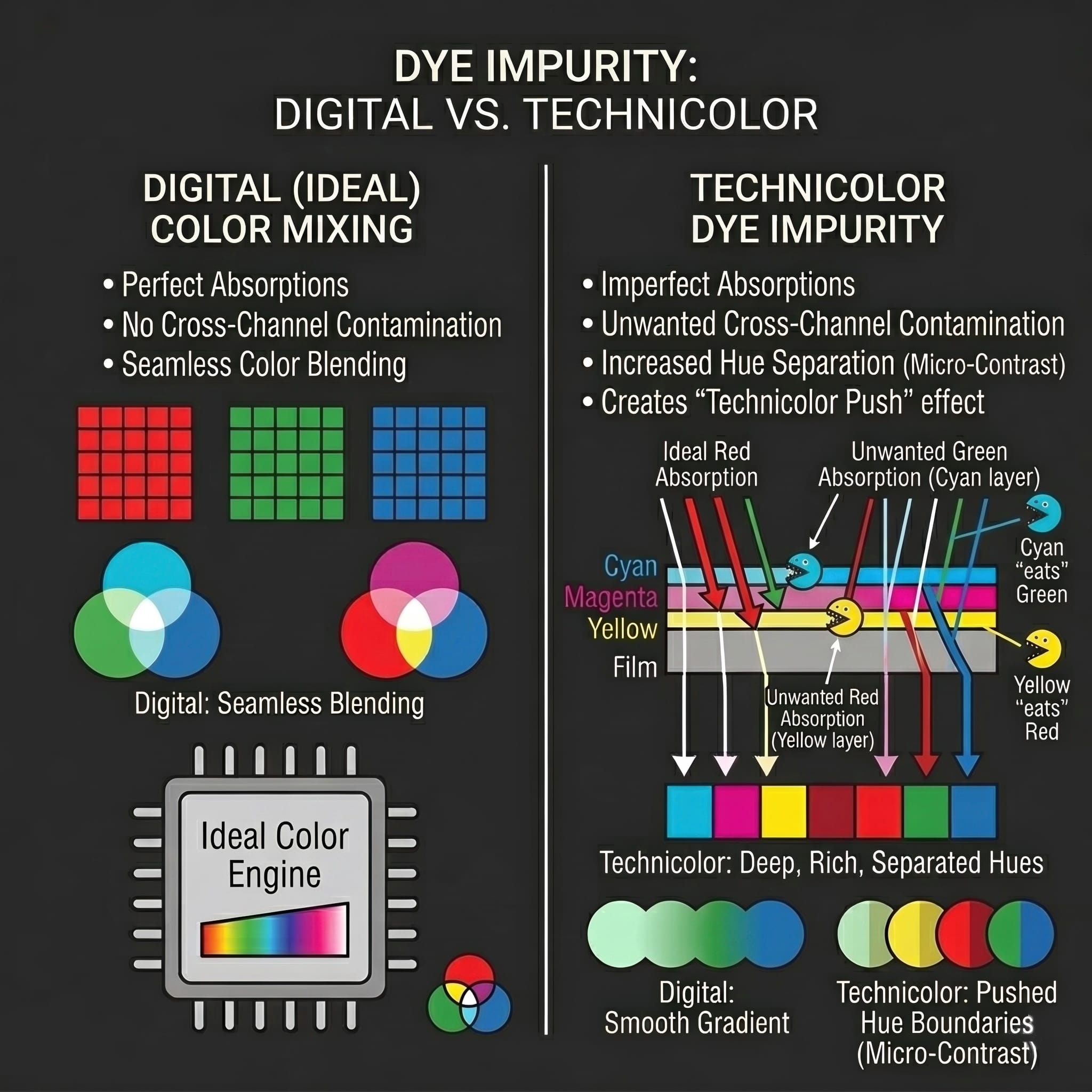
Dye impurity
Each dye absorbed light it shouldn’t — cyan ate green, yellow ate red — creating micro-contrast that pushes neighbouring hues apart. Colour that behaves like oil paint.
The difference
What changes. What doesn’t.
| LUTs & filters | Nx 3-Strip |
| Static per-pixel color map | Per-pixel, per-frame physics simulation |
| Same result on any image | Responds to luminance, color, saturation and position |
| Saturated colors get brighter | Saturated colors get darker — true subtractive density |
| Colors bleed into neighbours | Colors push apart — real separation |
| Color-wheel skin tones | Skin tones emergent from dye spectral impurity |
| Coloured grain noise | Neutral, silver-free dye-transfer texture |
| No spatial awareness | Halation, bloom, lens optics, dye spread, registration |
| Clean digital precision | Organic mechanical imperfection |
See inside the process
14 diagnostic view modes.
Isolate any stage of the pipeline — every separation, dye layer and curve — to see exactly what the process is doing.
The lineage
A century of color.
Get Nx 3‑Strip
Built for macOS & Windows.
GPU-accelerated on Metal, CUDA and OpenCL, with a multithreaded CPU fallback. Free to try with a watermark; one perpetual license unlocks every host.
Release notes·User manual·macOS 11 or newer·Windows 10 or newer
One license · every host · both platforms
Free to try. Yours to keep.
Renders with a watermark until activated. Perpetual license, free updates, seats released when you uninstall.
Get Nx 3‑StripTechnicolor® is a trademark of its respective owner(s). References to Technicolor, Technicolor Process IV, and historical motion-picture processes are used solely to identify the process being studied and reconstructed. Nx 3-Strip is not affiliated with, endorsed by, or sponsored by any trademark owner.